Noise
A kennel block is not just loud. It is loud in a way that sustained exposure changes animals.
What the environment actually produces02.1
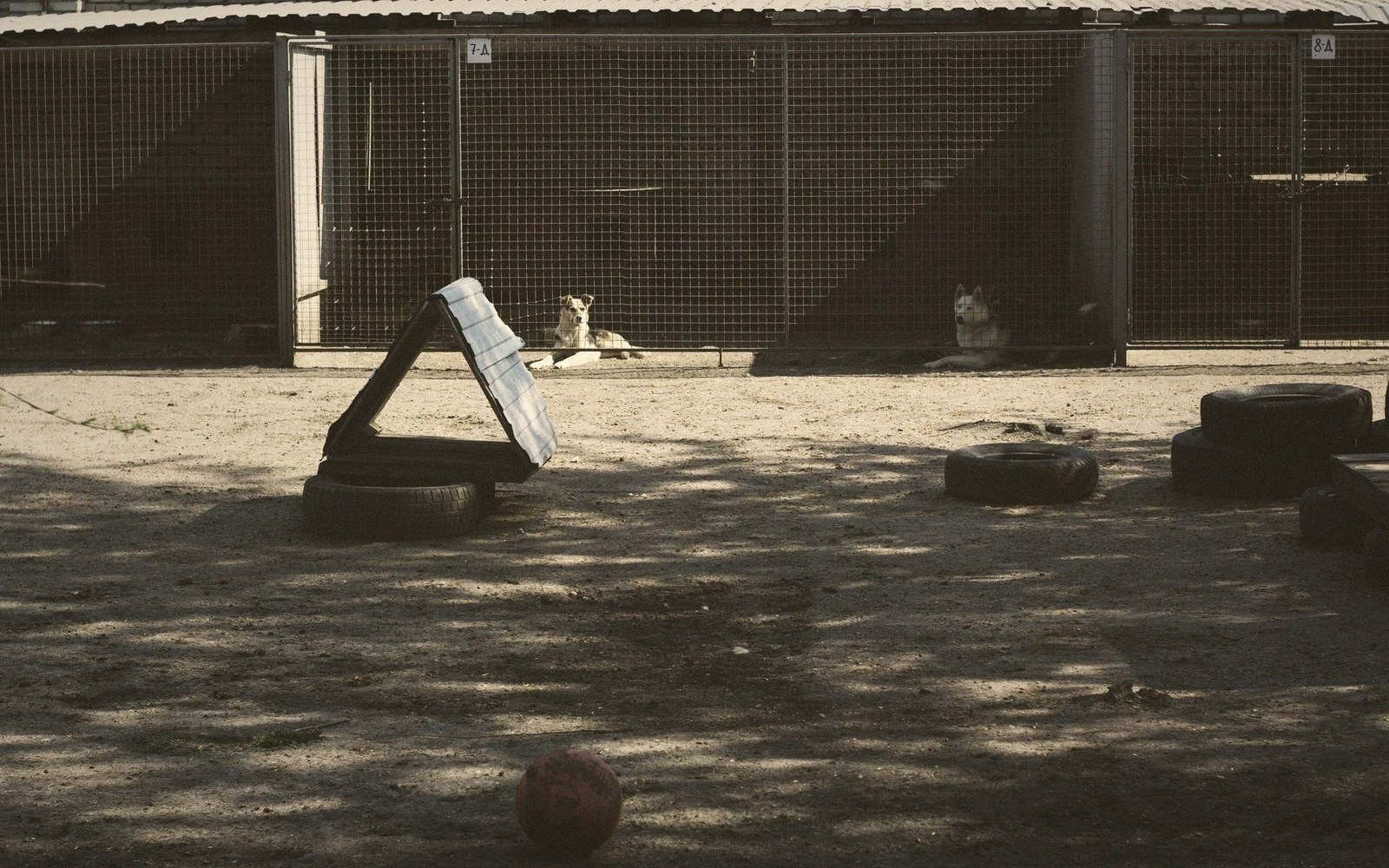
Walk into a working kennel block and the sound hits before anything else does. Dogs alarm-bark when a door opens; one sets off another; within seconds the whole row is at it. Concrete walls and mesh-fronted runs reflect and amplify rather than absorb, and the frequencies that dogs produce — sharp, high, repetitive — are exactly the frequencies that bounce hardest off hard surfaces. Measured sound levels in enclosed kennel blocks have been recorded above 100 decibels during peak periods, roughly equivalent to a chainsaw at close range. That figure is not an outlier; it is characteristic of the design.
The problem compounds when you consider duration. A building site worker exposed to 100 dB steps away at the end of a shift. A kennelled dog does not. Even at night, when the human staff are gone and the noise level drops, dogs in unfamiliar environments often sleep poorly, remain on alert and startle at small sounds — a boiler clicking, a gate settling — that would not register in a home. The auditory system never fully stands down.
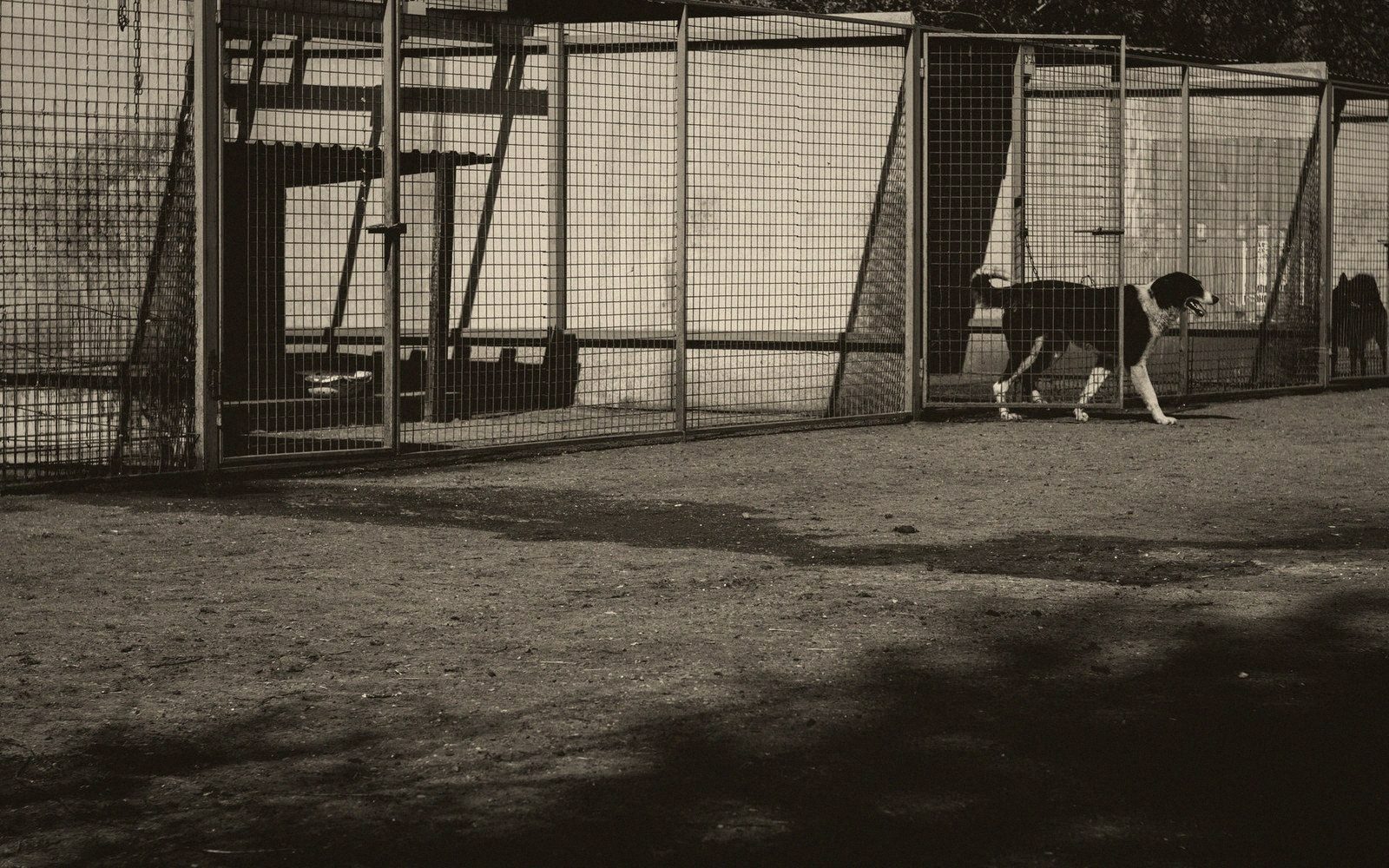
What this does to behaviour is measurable. Dogs that have been kennelled for more than a few weeks commonly show heightened reactivity: barking at triggers they would have ignored on arrival, difficulty settling, a baseline agitation that is increasingly hard to distinguish from temperament. Staff who have watched the same dog across several weeks of kennel life will often describe the trajectory quietly — calmer at intake, progressively more strung out as the weeks accumulate. This is not a character flaw or a behaviour problem in the usual sense. It is the kennel working on the animal. The observation that beats the test matters enormously here, because experienced daily observers are the only people who can tell you which animals have changed and in which direction.
What shelters do, and what actually helps02.2
The acoustic problem is partly structural and partly operational, and the structural part is expensive to fix. Some newer or purpose-built facilities use acoustic panels, sound-dampening ceilings and building layouts that separate small dogs, large dogs and intake animals into distinct zones, reducing the cascade effect where one barker starts the rest. These designs do make a measurable difference — but most operational shelters are working in buildings that were not designed with acoustics in mind, sometimes in converted industrial units or old agricultural premises, and retrofitting is rarely straightforward.
Operationally, the options are more accessible. Individual animals are taken out of the block for dedicated quiet time — a staff room, a garden, an empty intake pen — where the ambient noise level is lower and there is no neighbour to react to. Enrichment that occupies the nose and jaw tends to suppress vocalisation: a dog working on something to eat cannot bark at the same time. Careful management of the daily timetable can reduce the number of alarm triggers — staggering cleaning rounds so that fewer kennel doors open simultaneously, minimising foot traffic through the block outside meal and exercise times. None of these is a cure; all of them reduce the accumulation.
What shelters cannot do is fully protect a dog from the kennel environment over a long stay. This is one of the strongest arguments for fostering, where even a few weeks in a home resets the auditory baseline, gives the nervous system a period of genuine quiet and sometimes reveals — in the absence of kennel reactivity — an animal whose temperament assessors had begun to misread. A dog that sounds unplaceable on paper, on the basis of kennel observations, will sometimes walk into a foster home and be unremarkable within a fortnight. The kennel was the problem, not the dog.
This matters enormously at the point of matching. Behaviour that has accumulated from noise stress — reactivity, difficulty settling, a hair-trigger bark — will often diminish significantly after a period of decompression, and adopters should be told this plainly. It changes what they are preparing for. The noise a dog carries out of a kennel is not necessarily the noise it will bring into a home.
Measured sound levels in enclosed kennel blocks have been recorded above 100 decibels during peak periods, roughly equivalent to a chainsaw at close range.